The Opportunity Cost Nobody Talks About
About Maya AutoTrading: Maya is a fully automated options trading system. You connect your brokerage once and it handles everything from there — entries, exits, position sizing, and trade management. You don't place trades, you don't monitor positions, you don't make decisions during market hours. It just runs. See how it works.
Let me tell you what happened to a typical stock investor over the last two months.
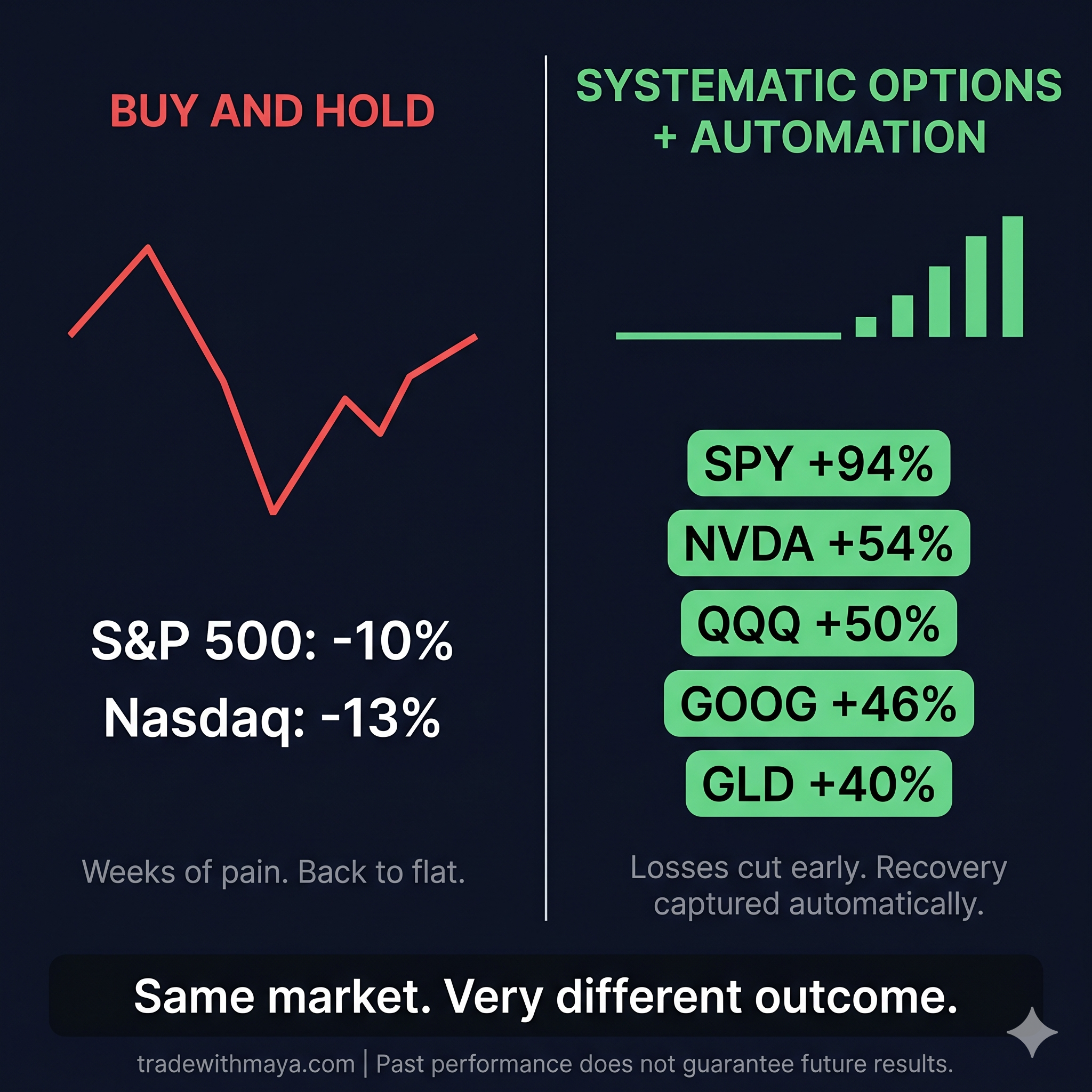
In early April, headlines started coming in about new tariffs, Iran tensions, and potential trade war escalation. Markets didn't like it. The S&P 500 dropped over 10%. The Nasdaq fell more than 13%. If you owned stocks (index funds, tech names, anything), you watched your account bleed for weeks.
Most people froze. That's not a personal failure. That's just how humans are wired. When red candles stack up day after day and every financial headline is screaming, your brain does not say "great entry point." It says "wait and see."
So you waited.
Then the recovery came. Fast and sharp, the way recoveries always do. By the time things felt safe enough to buy, most of the move was already done.
That's the opportunity cost nobody talks about. Not just what you lost during the selloff, but what you didn't make during the recovery, because you were still shaken from everything that came before it.
The $250 vs $30,000 Problem
If you held SPY through this correction, you're roughly flat on the full round trip. You sat through weeks of pain and came out about where you started. The emotional toll was real and the gains were minimal.
Here's where owning stocks versus trading options methodically makes a real difference. Each options spread costs around $250 to enter. If a trade goes against you early, you might be sitting on a $50 loss. That's easy to cut. There's no internal debate, no convincing yourself to hold on, no anchoring to what you paid. You close it and move on.
Compare that to a stock position. If you put $30,000 into SPY and it's now showing $4,000 in losses, the psychological math is completely different. You freeze. You tell yourself it'll come back. You hold because selling feels like confirming the loss. That's how a correction turns into a much bigger problem for stock holders who bought at the wrong time.
What Maya Did During the Selloff
Maya's account was essentially flat while the S&P dropped 10% and the Nasdaq dropped 13%. Not because the positions didn't go against the algo (some did), but because each trade is small enough that the exit rules actually get followed. When a spread drops to a certain threshold, the system closes it. No attachment to the original thesis, no hoping it turns around.
The losses that did happen were small and caught early, long before they could compound into something that actually hurt the portfolio. That's the real reason the account stayed flat. Not just defined risk on paper, but aggressive loss management in practice, and that only works because no single trade is large enough to feel catastrophic when it goes wrong.
April 2025 Correction Scorecard
-10%
S&P 500
-13%
Nasdaq
~Flat
Maya AutoTrading
The Recovery: What the Algorithm Did While Everyone Else Waited
When the recovery started, the system did what a human almost never actually does after a painful few weeks: it deployed capital into the bounce.
Here are the positions opened automatically during and immediately after the bottom:
All trades are real, live positions executed automatically by the Maya algorithm. Past performance is not indicative of future results.
That's the other side of the opportunity cost. Not money lost, but money left on the table because you were waiting to feel safe.
Why Options Make This Possible in a Way Stocks Don't
If you owned 100 shares of SPY at $550 and it dropped to $495, you lost $5,500. You didn't know in advance how far it would fall. There's no built-in rule in stock ownership that says "exit here, max loss is $250."
With a bull call spread, you paid $250 to control the same directional exposure. The most you could ever lose on that position was $250, and that's set before you enter. During a correction, you're not making a live decision about when to fold because the trade already told you what the worst case looks like.
Why Automation Closes the Gap
And when the setup looked right on the other side, the algorithm entered eleven positions across SPY, QQQ, NVDA, GOOG, MSFT, GLD, TSLA, and SMH. Not because someone made a bold call at the bottom. Because the entry conditions were met and the system opened the trades the same way it always does.
That's the part that's genuinely hard to replicate on your own. You can understand the logic. You can know what you're supposed to do. But after watching your account drop for weeks, actually putting money to work into eleven positions right after the bottom is something most retail investors never follow through on. The news is still bad. The context still feels uncertain. Your gut says wait another week. By then the move is half over. The algorithm just runs the rules regardless of what the headlines say that morning.
The opportunity cost of owning stocks through a correction isn't just the losses on the way down. It's also missing the recovery on the way back up, because both moments are too emotionally charged to navigate without something mechanical doing it for you.
The last two months were a pretty clear example of that gap. For anyone still on the sidelines, the door is open.
Maya AutoTrading — $47 Your First Month
Connect your brokerage once. Maya handles everything — entries, exits, position sizing, trade management. You just watch it work.
Get Started for $47Share this post
Comments 0
Leave a Comment
No comments yet. Be the first to comment!
Stay Updated
Subscribe to our newsletter for the latest trading insights and updates.
Autotrading is Live
Maya sends the signals. PeakBot submits the orders to your brokerage. You never lift a finger.
See How It Works