Markets are recovering. When does Maya start trading again?
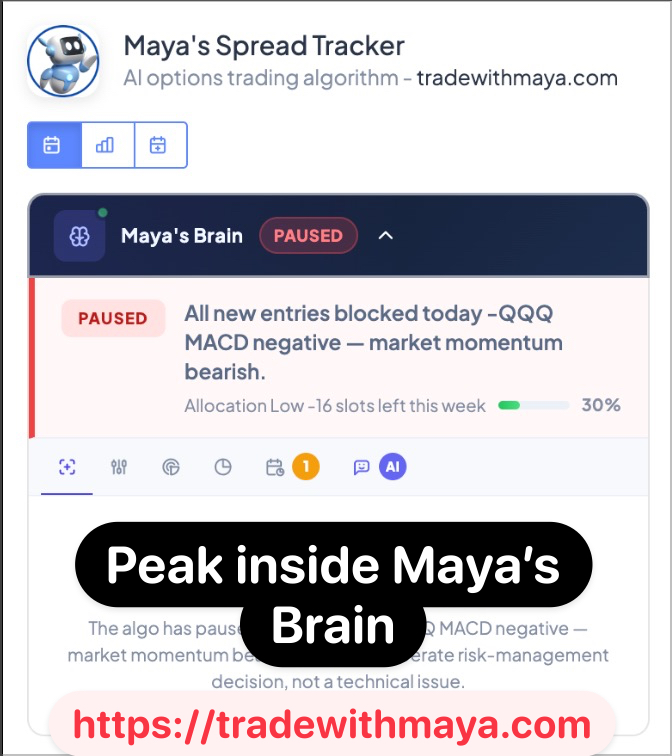
Maya has been in Cautious / Paused stance for about a week now, and a few of you have asked what she's waiting for. Fair question. Here's the full picture.
What Maya has been doing while markets sold off
Maya wasn't sitting still during the selloff. She was actively cutting losers early before they could turn into bigger losses. That's not lucky timing. That's the exit system working exactly as designed. When a trade hits a stop, Maya closes it. She doesn't wait to see if it bounces. She doesn't average down. She takes the defined, controlled loss and moves on.
Nobody likes a loss. But the alternative, holding through a sustained drawdown with no idea where the bottom is, is how accounts blow up. When markets start taking leg after leg lower, there is no bottom you can call in real time. The traders who survive long term are the ones who accept a small, defined loss and live to trade another day.
You can see Maya's live stance at any time by visiting Maya Spread Tracker and looking for the Maya's Brain panel. PeakBot members see the same panel on their dashboard.
Elevated VIX puts the brakes on too
Even before the full pause, elevated VIX was already tightening Maya's entry gates. When VIX climbs above 20, Maya automatically reduces new trade allocation and tightens exit triggers, using the short strike instead of the long strike as the price breach threshold. In plain English: at high VIX, Maya demands more margin of safety before entering, and exits faster when things go wrong. This is by design. High volatility means wider bid-ask spreads, less predictable pricing, and a higher chance that a normal pullback turns into a sustained move down. Maya respects that.
The 9 exit rules working behind the scenes on every open trade
While new entries are paused, exit monitoring never stops. Every open position is checked against all 9 rules on each processing cycle. Here is what that system looks like:
| # | Rule | What it does |
| 1 | Dividend Risk | Exits before the ex-dividend date if the short strike is at assignment risk. Avoids forced assignment. |
| 2 | Profit Target | Closes when the spread reaches 94% of its maximum value. Locks in the gain before a reversal can eat it back. |
| 3 | DTE Stop Loss | If loss exceeds 50% with 15 or fewer days to expiration, close it. Time is no longer an ally at that point. |
| 4 | Hard Stop Loss | If any trade loses more than 50% of its entry value at any point, it is closed. No exceptions, no waiting. |
| 5 | PNR Violation | The Point of No Return is a stock-price floor calculated from ATR and the long strike. If the stock drops below it, Maya exits early rather than waiting for a 50% stop. |
| 6 | Expiry Week | All positions are closed by Wednesday of expiration week. Avoids theta decay, assignment risk, and illiquid end-of-week pricing. |
| 7 | QQQ MACD Exit | When QQQ's MACD turns bearish AND the stock drops below its long strike (or short strike at high VIX), Maya exits. Broad market deterioration is not the time to hold individual positions. |
| 8 | Earnings Exit | Exits any trade 3 business days before an upcoming earnings report. Earnings cause unpredictable gaps that break all spread pricing assumptions. |
| 9 | Stock MACD Reversal | If the individual stock's own MACD signals a bearish reversal (after the trade has been open at least 3 business days), Maya exits that specific position even if the broader market is fine. |
Every one of those rules is why you are getting closing alerts during a rough market instead of watching positions bleed out. The system is doing its job.
Zoom out before you judge a bad month
Maya has returned +45% ROI over the past year. That number includes every rough stretch. The only way to capture that annual return is to stay in through the uncomfortable periods. The traders who quit during a drawdown lock in their losses and miss the recovery. It happens every single time.
When does Maya come back?
Maya does not try to catch bottoms. Violent recoveries and gap-up days are actually bad for entries. Nobody can catch those moves in time, and chasing them is how you end up buying the top of a dead-cat bounce. As the saying goes in trading: "Being late to the market is your insurance for being right." Maya would rather miss the first 5% of a recovery and enter on confirmed momentum than be first in and wrong.
What Maya is specifically waiting for: QQQ MACD(5,13,5) to cross bullish. When that happens, her entry gate reopens. You can check it yourself on any charting platform using those exact settings. When QQQ's MACD(5,13,5) crosses over, that is Maya's green light.
If the Iran deal holds and the macro settles down, we could see new trades as early as Tuesday or Wednesday of next week. When Maya does start back up she tends to move quickly, so expect a cluster of new alerts in the first few active days.
Stay tuned. Good times are ahead.
Team Maya
Share this post
Comments 0
Leave a Comment
No comments yet. Be the first to comment!
Stay Updated
Subscribe to our newsletter for the latest trading insights and updates.
Autotrading is Live
Maya sends the signals. PeakBot submits the orders to your brokerage. You never lift a finger.
See How It Works