Jensen Huang Steps Down: What It Means for NVDA and the Market
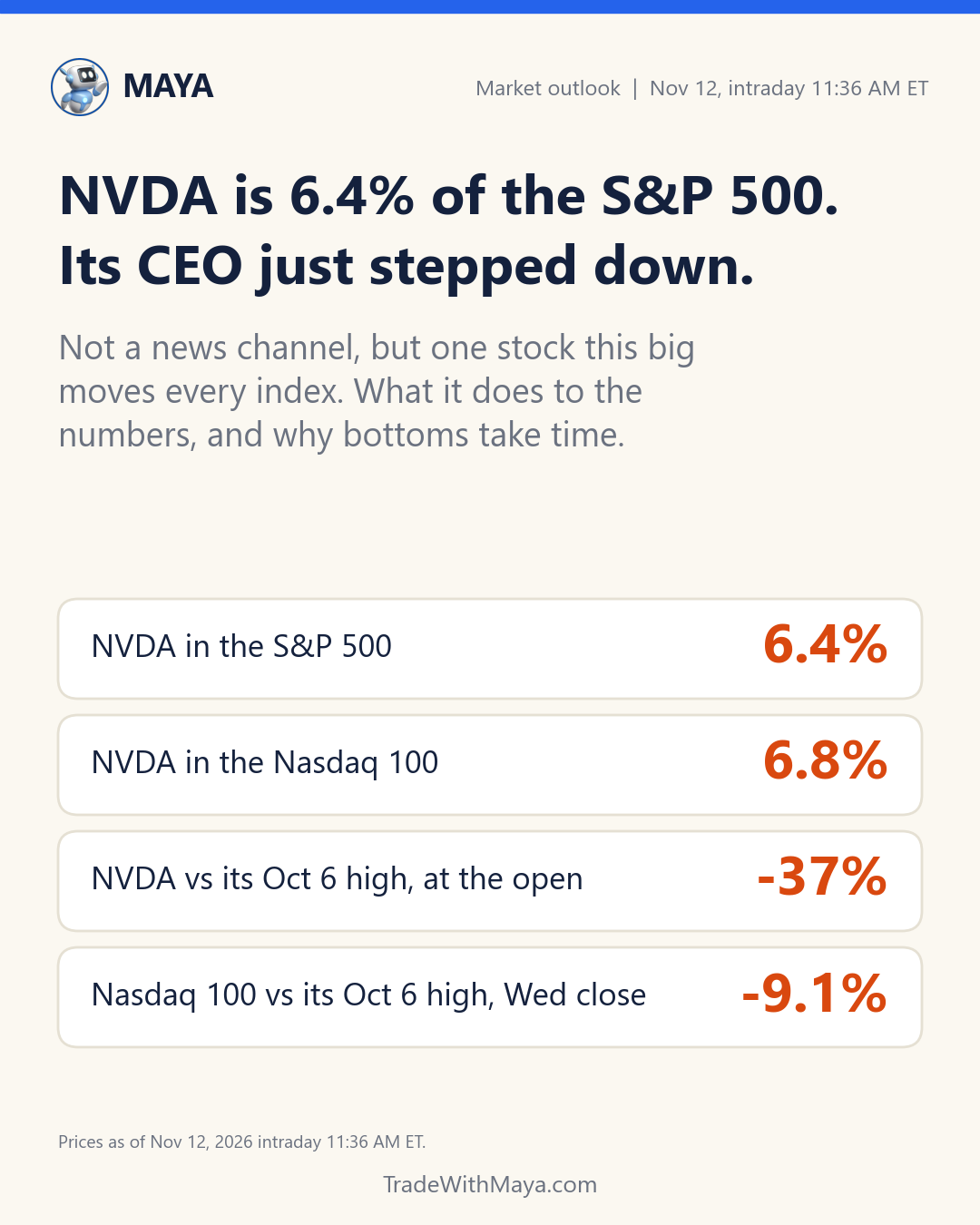
Who was brave enough to buy the dip in NVDA this morning? I was. I bought a few hundred shares in my 401k at exactly $150 at the open, nothing crazy, and I have not sold yet. It could easily go the other way from here. It is my own money, not a Maya trade, and not advice. To me this looks like a classic knee-jerk reaction, but earnings are Tuesday Nov 17 and nobody knows what comes after that, so you cannot get too brave either. Now the story. We are not a news channel, and I try not to chase headlines, but I cannot ignore this one. NVDA's CEO Jensen Huang stepped down overnight, and NVDA is the second biggest stock in both the S&P 500 and the Nasdaq 100, so this is not a one-stock story anymore. This year has been one thing after another: a war, a V-shaped recovery, a correction, and now a bomb with a ticker symbol.
Why I am writing about one stock
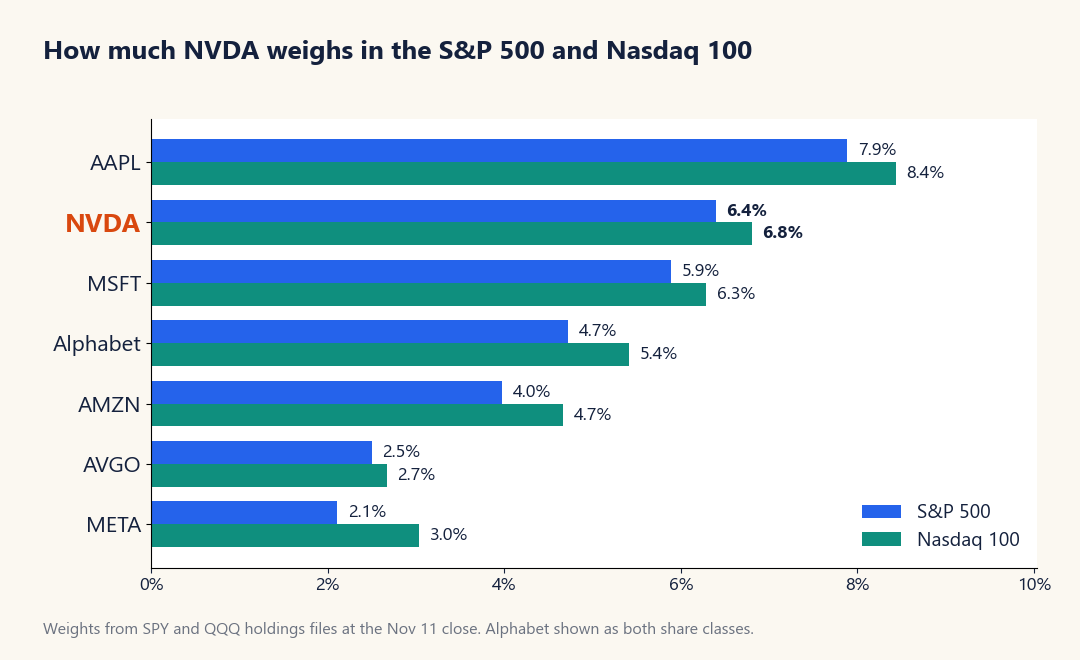
Because of the weight. At Wednesday's close NVDA was 6.4% of the S&P 500 and 6.8% of the Nasdaq 100, a roughly $4.2 trillion company and second only to Apple in both. Down about 13% before the open, it is worth around $0.5 trillion less than it was at the close, and that one stock is good for about 0.8 points off the S&P 500 and 0.9 off the Nasdaq 100 before anything else moves. Futures were down 0.7% and 1.4% this morning, so NVDA is a big part of the story but not all of it.
Here is the simple math, weight times move, so you can do it yourself next time a giant stock has a bad day:
| If NVDA falls | S&P 500 drag (points) | Nasdaq 100 drag (points) |
|---|---|---|
| 10% | 0.64 | 0.68 |
| 20% | 1.28 | 1.36 |
| 30% | 1.92 | 2.04 |
It is rough, because weights change as prices move, but it explains why a single ticker can decide whether the whole index is red or green on a given morning.
What happened
The board announced that Huang resigned as CEO and left the board, effective immediately, after a probe that started Nov 8. CFO Colette Kress is interim CEO and there is no permanent successor. Huang never named one, and that is the part that worries the market. He built this company over 33 years, so the stock is not just pricing a personnel change, it is pricing the question of who steers the biggest AI company in the world. Earnings are still on for Tuesday Nov 17.
The stock was already well off its highs. NVDA closed at $239.24 on Oct 6 and at $173.73 on Wednesday, down 27%. At about $151 at the open it is down about 37% from that high.
We were already hurting
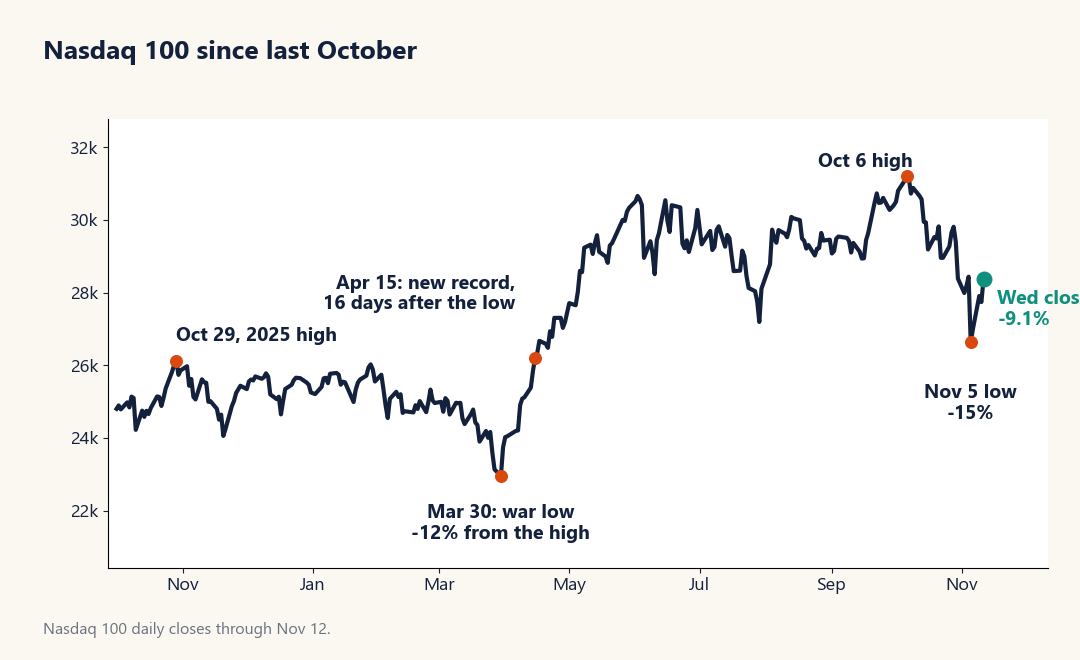
This year has been a lot. The Iran war took the Nasdaq 100 12% down by Mar 30, and then it hit a new record 16 days later. That was a proper V. Then this autumn it fell 15% from the Oct 6 high to the Nov 5 low, bounced 6.6%, and was still 9.1% under the high on Wednesday. If the futures hold, it opens more than 10% under (my math, not a quote). So the correction already happened, and this is a new bomb landing on a market that had only just started to heal.
Is this a V again?
It could be. V-shapes are real, and spring proved it. But they are the exception. Since 1985 the Nasdaq 100 has had 34 pullbacks of 10% or more. The final low came a median 14 days after the first 10% drop, and 11 of 34 took more than 30 days to bottom. After the low, ordinary corrections needed a median 42 days to reach a new high, and bear markets 116. Even this summer's modest 11% dip took 112 days from the high to a new high.
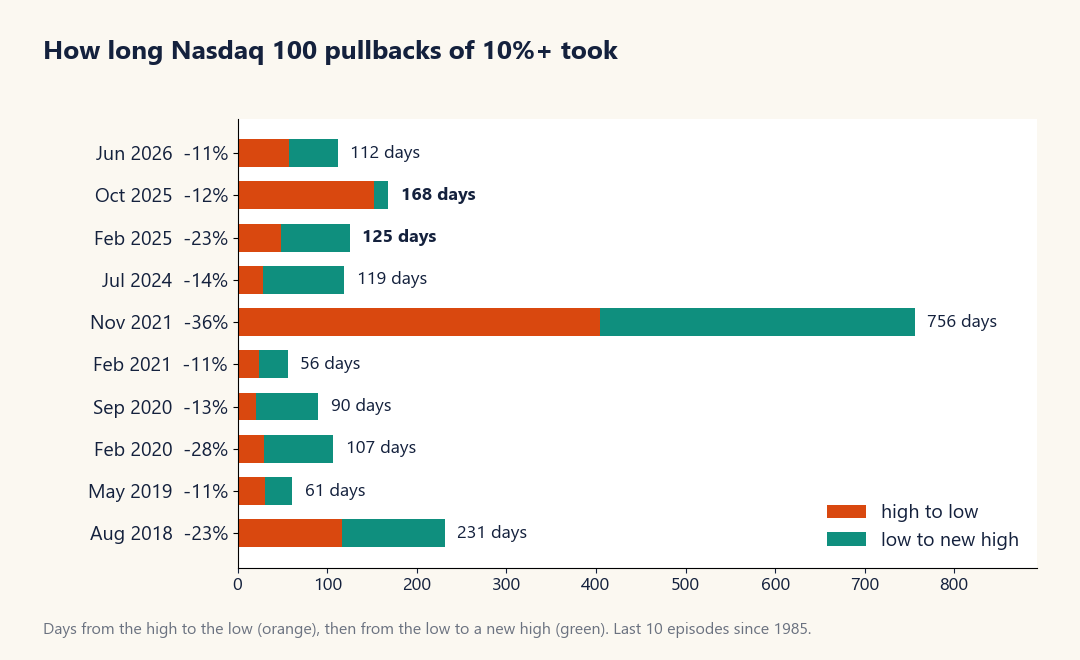
My honest read is that bottoms are usually a process, not an event. You get a flush, a bounce, a retest, and some boring chop before the market is ready to go again. If NVDA stays in trouble, I would plan for weeks, not days. If the new CEO situation settles fast, the V is still possible.
Big companies are built to outlive one person
Here is the part of this story I think the market is underrating. NVDA is not a garage startup anymore. It has more than 42,000 employees and about $303 billion of revenue over the last twelve months, an 11-person board where everyone but Huang is independent, and a CFO who has been there for years. Huang was the visionary, and he built the thing. But past a certain size, a company stops being one person's idea and becomes a machine run by thousands of smart people, with products, customers and contracts that keep going on Thursday the same way they did on Wednesday.
That is why big companies are big. The founder phase, where everything depends on one person's instincts, is behind them. So I went back and looked at ten times a big company changed its top job. Here is what happened to the stock over the next twelve months, against the S&P 500:
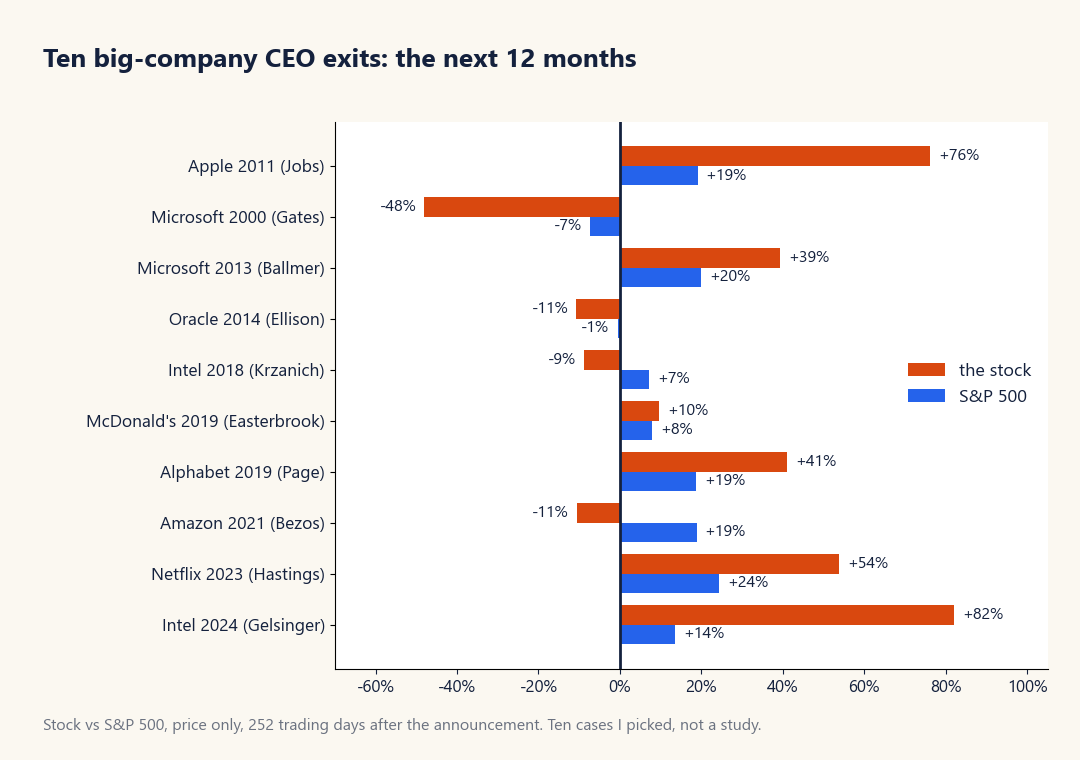
The stock beat the S&P 500 in 6 of the 10 cases, and it was higher in absolute terms in 6 of 10. The median stock rose 24% against 16% for the index. When Jobs stepped down, Apple was up 76% over the next year, against 19% for the S&P 500. Alphabet, Netflix and Microsoft after Ballmer all beat the index too. Even Intel, which fell 13% in the three months after Gelsinger left, finished the year up 82%.
It is not all green, and I do not want to cherry-pick. Microsoft fell 48% in the year after Gates stepped down, though that was the dot-com bust. Amazon lagged the index after Bezos handed over, and Oracle and Intel in 2018 did too. The honest takeaway is that the exit by itself did not decide anything. It was close to a coin flip against the market, and none of these companies fell apart. The business and the bench behind the CEO mattered much more than the name on the door.
There is a real counterpoint, and you should hear it. Most of those were planned handoffs with a named successor, and many founders stayed on as chairman or on the board. Huang left suddenly, left the board too, and the interim CEO is the CFO with no permanent pick. That is a messier situation, and it is why I would not expect the stock to snap back in a straight line. But messy is different from broken. Choosing a new CEO, and some quarters of proof, is the work in front of the company. It is not the end of it.
So who buys the dip?
I did, this morning. I bought a few hundred shares in my 401k at exactly $150 at the open, nothing crazy, and I have not sold yet. I want to be clear that it could easily go the other way from here. It is my own money, not a Maya trade, and I am not telling you to do it. To me this looks like a classic knee-jerk reaction, because the company still has the products, the customers and the demand it had on Wednesday.
But you cannot get too brave either. Earnings land on Tuesday Nov 17, and a company can beat the numbers and still drop, or miss and still rally, especially when nobody knows what the CEO change does to the outlook. Buying an overreaction is one thing. Sizing it like you know what earnings will say is another. Being brave is fine. Being brave and big going into earnings is how people get hurt.
What I am keeping an eye on
PPI tomorrow, because the 10-year is near 5% and the market is sensitive to inflation surprises. Tuesday's NVDA earnings under the interim CEO. And whether buyers keep showing up near the lows or only for a day. Maya's rules size up and down with market stress, so I do not need to call the bottom, I just follow them. That is my read, not advice.
Share this post
Comments 0
Leave a Comment
No comments yet. Be the first to comment!
Stay Updated
Subscribe to our newsletter for the latest trading insights and updates.
Autotrading is Live
Maya sends the signals. PeakBot submits the orders to your brokerage. You never lift a finger.
See How It WorksThe Books
Trade Like a Machine
Build a rules-based options trading system